


En ESIC University, nuestra responsabilidad social va más allá de la formación académica. Como institución educativa comprometida con el progreso sostenible, alineamos nuestras acciones con los Objetivos de Desarrollo Sostenible (ODS) establecidos por la Organización de las Naciones Unidas (ONU). Este compromiso es fundamental para impulsar el cambio positivo en la sociedad. Aunque como institución trabajamos en diversas áreas relacionadas con los 17 ODS, enfocamos nuestros esfuerzos de manera especial en los siguientes ODSs:


En este apartado presentamos una serie de iniciativas y acciones que demuestran el compromiso de ESIC University con los Objetivos de Desarrollo Sostenible (ODS). Las evidencias detalladas están en inglés, ya que este es el idioma requerido por las instituciones internacionales a las que reportamos y rendimos cuentas cada año, con el objetivo de colaborar en la medición y el seguimiento del impacto global en el cumplimiento de los ODS.
LIFELONG LEARNING MEASURES
ESIC University, in its compromise to guarantee a quality, inclusive and equitable education, promotes opportunities for improvement following the roadmap set out by the SDG4, transforming its commitments into actions.
Free courses leading to certificate:
- Proyecto #RelánzaT: ESIC offers free, certified training to people at risk of social exclusion, in collaboration with NGOs and through volunteers from the ESIC community. The courses are adapted to the needs of the participating groups and award a certificate of achievement from ESIC University. The project's page describes the groups it serves (women, young people, people over 50, prisoners, people with disabilities, among others) who are unemployed or in precarious work. https://www.esic.edu/institucion/sostenibilidad/proyecto-relanzat
Free access to campus facilities and equipment:
- Library: Access to the ESIC Library is universal for all persons who meet the requirements established in the regulations. Students have access to both the study facilities and the equipment available, such as computers and an extensive collection of books and electronic resources. This provides them with a suitable environment for learning and academic development. https://www.esic.edu/institucion/biblioteca
Free access to online resources:
- ESIC Play: ESIC Play is a micro-learning app that offers free educational content on marketing, business and technology, accessible to people outside the institution. Its public description presents the training as "100% free". https://apps.apple.com/us/app/esic-play/id6466413100
- Proyecto #RelánzaT: Proyecto #RelánzaT makes audiovisual training content and PDF materials available to people outside ESIC, aimed at small businesses, self-employed professionals and unemployed people. The project uses resources produced by ESIC, available in ESIC Play and Rethink, together with materials developed by its volunteers. The materials on the project website cover marketing, sales and communication, finance and legal, soft skills and digital strategy and e-commerce. https://www.esic.edu/masesic/relanzate/contenidos-formativos
- Rethink by ESIC: Rethink by ESIC is a publicly accessible, free blog of knowledge sharing and learning, with articles on marketing, management, the digital economy, sales and technology. Its content, written by professors from ESIC's campuses and by external experts and professionals, offers explanations, analysis and practical examples that can be read without being enrolled at the institution. https://www.esic.edu/rethink
Ad hoc:
- Presentaciones de libros y encuentros de divulgación: ESIC organises one-off events linked to publications on business and professional topics. One example is the presentation of the book «Empresas Magnéticas», announced for 17 September 2026, 18:30 to 19:30, in person at the ESIC Valencia campus (Avenida Blasco Ibáñez 55). Its programme addressed leadership, talent management and employer branding, with the participation of the author and industry professionals. The event page includes a registration form ("Inscríbete en el evento") that asks whether the registrant is an alumnus (yes or no). https://www.esic.edu/eventos/presentacion-del-libro-empresas-magneticas
The ESIC announcement invites attendees to an event of reflection and collective discussion around an anthology of 28 perspectives on times of change, at the ESIC campus on Avenida Blasco Ibáñez 55, Valencia. The event page includes a registration form ("Inscríbete en el evento") that asks whether the registrant is an alumnus (yes or no). https://www.esic.edu/eventos/presentacion-del-libro-crisis-transformacion-evolucion
On programmed basis:
- Agenda de ESIC Business & Marketing School: ESIC publishes a public calendar of activities with masterclasses and round tables, stating date, time and location. The calendar on its website can be filtered by campus. https://www.esic.edu/eventos-esic-business-marketing-school
- Hoy es Marketing is an annual event organised by ESIC with talks and debates on marketing, business and technology, with the participation of professionals and business leaders. The Madrid 2025 edition was held on 3 April, in person at IFEMA Madrid, with registration open until capacity was reached, allowing the participation of people from outside the institution. More than 20 editions have been held since the first in 2004. Registration is through a form on the event website, hoyesmarketing.com. https://www.esic.edu/dossier-hoy-es-marketing-2025
- Masterclasses gratuitas de ESIC: ESIC's free masterclasses: the page invites visitors to select events and complete a form to receive the access link; on the day of the event they receive an email with the link. It presents content on marketing, business administration (ADE) and communication. https://www.esic.edu/webinars-masterclass/grado
On programmed basis:
- Cursos especializados para profesionales: ESIC offers a programme of short courses aimed at developing professional skills in areas such as management skills, product management and project management. The offer includes in-person and online formats, with duration and start dates published. Examples of short executive courses: Curso Especializado en Habilidades Directivas and Curso Especializado de Product Manager (CEOPM). https://www.esic.edu/master-y-postgrado/executive-programs/business
Examples of short executive courses:
- Curso Especializado en Habilidades Directivas: https://www.esic.edu/master-y-postgrado/curso-especializado-habilidades-directivas
- Curso Especializado de Product Manager: https://www.esic.edu/master-y-postgrado/curso-especializado-online-de-product-manager-ceopm
- Vocational training: ESIC offers a regular programme of Higher Vocational Training Cycles (Ciclos Formativos de Grado Superior), taught in person. In Madrid: Marketing and Advertising, Administration and Finance, International Trade, Multiplatform Application Development and Web Application Development. In Barcelona: Marketing and Advertising, Administration and Finance, and International Trade. The cycles last two academic years (2,000 hours) and include work-based training in a company, oriented to the development of professional skills. Access is open to candidates who meet the academic and admission requirements, without needing to be previously enrolled at ESIC. Example: Técnico Superior en Administración y Finanzas (Higher Technician in Administration and Finance) in Madrid. https://www.esic.edu/ciclos-formativos
Examples of vocational training cycles:
- Técnico Superior en Administracion y Finanzas en Madrid: https://www.esic.edu/ciclos-formativos/grado-superior-administracion-finanzas-madrid
Ad hoc:
- Talleres de capacitación profesional: ESIC convenes one-off practical training sessions for external professionals. One example is the in-person workshop «Tu primer plan de IA, por dónde empezar. Pon la IA a trabajar en tu empresa» (Your first AI plan: where to start. Put AI to work in your company), announced for 23 September 2026, 09:00 to 11:00, at Foment-Gandía (Gandía). It was aimed at business owners, managers, department heads, professionals and entrepreneurs interested in bringing artificial intelligence into their business, and its programme dealt with the fundamentals of starting to use AI in a company from a strategic and practical perspective. The event page includes a registration form ("Inscríbete en el evento") that asks whether the registrant is an alumnus (yes or no). https://www.esic.edu/eventos/taller-tu-primer-plan-de-ia-por-donde-empezar-pon-la-ia-trabajar-en-tu-empresa
Ad hoc:
- Talleres educativos en la comunidad empresarial: ESIC Business & Marketing School collaborates with local organisations to run training activities outside its campuses. As an example, AEDHE and ESIC organised a practical artificial-intelligence workshop at the association's headquarters in Alcalá de Henares (Calle Punto Net 4). The AEDHE announcement gives the session as Tuesday 3 February, 10:00 to 13:00, with registration through a form. The activity featured live demonstrations, exercises and participatory dynamics to teach the practical and responsible use of AI tools for productivity, communication and work organisation. https://aedhe.es/actualidad/aedhe-y-esic-business-marketing-school-organizan-taller-practico-sobre-inteligencia-artificial/
On programmed basis:
- Voluntariado educativo: Through MásESIC, ESIC's volunteering group, students can take part during the academic year in national projects, among them school support for children with learning difficulties, accompanying children with cancer in hospitals and marketing and communication advice for foundations. Its international volunteering offer, in countries such as Ecuador, Venezuela and Cameroon during the summer months, includes educational activities such as support classes given by students and professors. These initiatives take ESIC's educational activity to external groups and communities through the voluntary participation of its university community. https://www.esic.edu/alumni/mas-esic
- Código Ético de ESIC: The Code of Ethics establishes the equal participation of people in all areas of the institution's activity and a commitment to non-discrimination for any reason or kind. It also sets out a commitment to an educational offer accessible to all people, and extends its principles to relations with stakeholders and to activities carried out with partner organisations. These provisions constitute the institutional framework used to justify inclusive access to lifelong learning activities. https://www.esic.edu/themes/esic/pdfs/A4_CODIGO_ETICO_ESIC_2022.pdf
- Proyecto Diversidad de ESIC: The Diversity Project complements the Code of Ethics through a structure of procedures, policies and resources designed to promote equal opportunities and access to education. It expressly covers people who are discriminated against on grounds of gender, race, ethnic origin, religion or disability (functional diversity certified at 33% or more). Through the Diversity Technical Unit it provides physical and technological accessibility measures, guidance, grants and academic adaptations, and develops annual action plans integrated into ESIC's Quality Policy. These measures show the practical application of the institutional commitment to inclusion. https://www.esic.edu/institucion/proyecto-diversidad-esic-business-marketing-school
STUDENT ACCESS MEASURES
ESIC University is committed to achieving SDG5: Gender Equality, seeking to empower women and female students so that it has a multiplier effect, not only helping to promote economic growth, but also development at a global level, creating a fair and equal society.
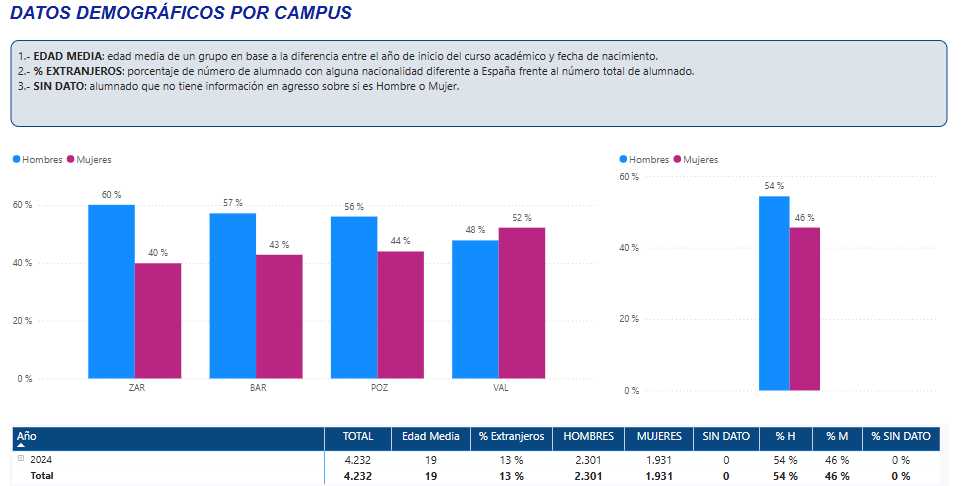
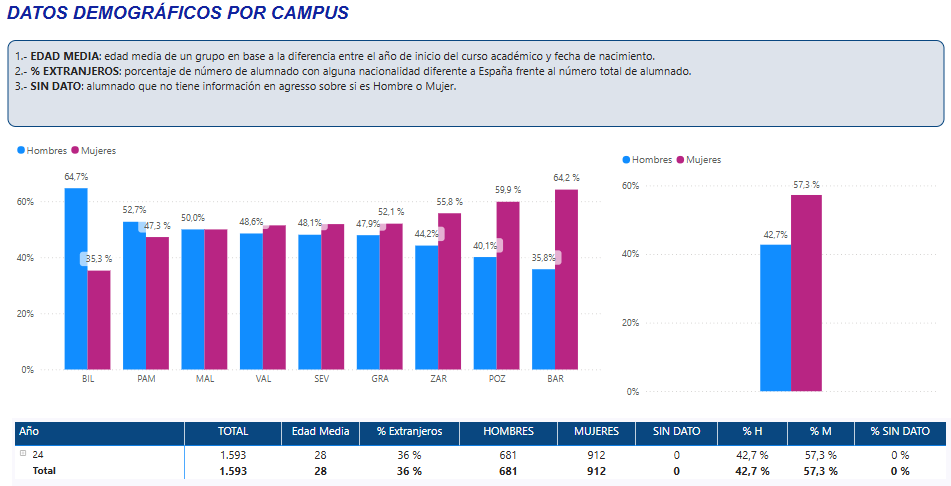
ESIC measures women's acceptance or new-entry rates every year. The information is collected during the admission process and recorded in Salesforce; when candidates become students, their data are transferred to the student information system (SIS). ESIC's quality management system (Blu) then reports the distribution by sex of admitted students. For the 2024 academic year, covering ESIC University and ESIC Business & Marketing School, it records 4,232 students admitted to bachelor's degrees and other higher-education degrees, of whom 1,931 are women (46%), and 1,593 admitted to master's programmes, of whom 912 are women (57.3%). The same report breaks the figures down by campus and shows the share of records without sex data, which is 0% in both cases.
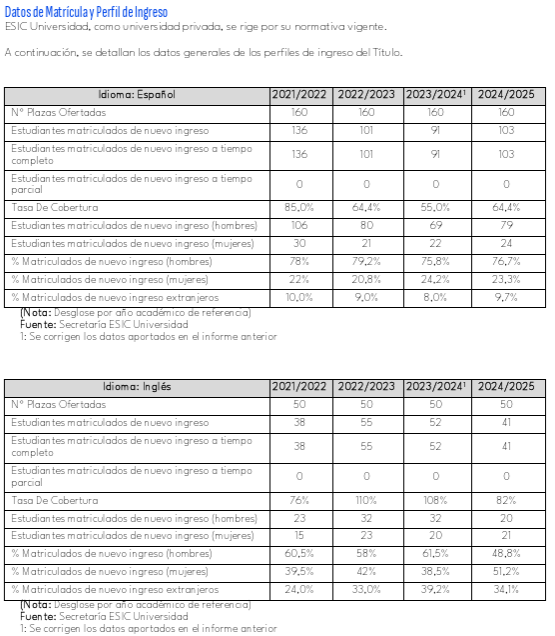
Monitoring is complemented by the annual programme reports, which include information broken down by sex to identify and compare the participation of women and men and to analyse its evolution by academic year and programme. The 2024/2025 annual report of the Bachelor's Degree in Business Administration and Management (Spanish- and English-taught groups), published on esic.edu, gives on page 6 the number and percentage of new students by sex for the last four academic years, with the Registry of ESIC Universidad as the data source. On page 7 it comments on the evolution: the share of men and women in the Spanish-taught groups remains stable compared with previous years, while in the English-taught group women outnumbered men among new students in the last academic year (51.2%).
New students, Spanish-taught group
| Academic year | New students | Women | Men | Women (%) |
|---|---|---|---|---|
| 2021/2022 | 136 | 30 | 106 | 22% |
| 2022/2023 | 101 | 21 | 80 | 20.8% |
| 2023/2024 | 91 | 22 | 69 | 24.2% |
| 2024/2025 | 103 | 24 | 79 | 23.3% |
New students, English-taught group
| Academic year | New students | Women | Men | Women (%) |
|---|---|---|---|---|
| 2021/2022 | 38 | 15 | 23 | 39.5% |
| 2022/2023 | 55 | 23 | 32 | 42% |
| 2023/2024 | 52 | 20 | 32 | 38.5% |
| 2024/2025 | 41 | 21 | 20 | 51.2% |
Example of a degree report: https://www.esic.edu/sites/default/files/2026-07/informe_anual_titulacion_grade_bbam_2024_2025.pdf. Page 6 includes the number and percentage of new students by sex. Page 7 comments on the evolution of the participation of men and women.
ESIC has a Specific Corporate Diversity Policy, part of its General Corporate Sustainability Policy, which expressly includes gender equality and applies to the educational community, including students and alumni. The policy establishes non-discrimination on grounds of sex, equal opportunities and equitable treatment for the people who study at or deal with the institution. It also provides for structures, instruments and procedures to ensure access to ESIC's educational activity. It is implemented through programmes, projects and action plans, with a process of approval, monitoring and annual review. In the policy document (pages 10 and 11), diversity includes gender equality, and the policy binds the whole ESIC community: administrative and service staff, teaching and research staff, students and alumni. Its first principle guarantees that no member of the ESIC community is discriminated against on grounds of sex, among others; the second promotes equal opportunities and equitable treatment for everyone who works or studies at the institution; the eighth commits ESIC to put in place the structures, instruments and procedures needed to ensure everyone's access to its educational, research and work activity. The policy is drawn up by the Sustainability Department, reviewed by Corporate Reputation and approved by the Management Committee, and it is reviewed every year. It refers expressly to SDG 5 (gender equality) and to the principles of the Diversity Charter.
This framework is complemented by the Diversity Project, which includes welcome and guidance procedures for new students, scholarships and grants to facilitate access to education, and inclusion support measures. The project page states that ESIC aims to offer education and social and labour inclusion to everyone, especially to people discriminated against on grounds of gender, race, origin, religion or functional diversity. The project is national in scope, is led by ESIC's General Secretary and develops action plans every year that are integrated into ESIC's Quality Policy; its Diversity Technical Unit carries out the actions.
Among the actions aimed specifically at women is the Beca Mujer + Liderazgo, which offers financial support to access certain postgraduate programmes. According to its page, ESIC's Diversity Project uses it to support women's contribution in the professional world: it grants 50% of the tuition fee (the enrolment fee is excluded) to study the MBA Full Time, the International MBA or the Executive MBA, and it is national in scope.
Corporate Sustainability Policy: https://www.esic.edu/sites/default/files/2024-11/09%20POLITICA%20CORPORATIVA%20DE%20SOSTENIBILIDAD.pdf
Proyecto Diversidad de ESIC: https://www.esic.edu/institucion/proyecto-diversidad-esic-business-marketing-school
Beca Mujer + Liderazgo: https://www.esic.edu/beca-mujer-y-liderazgo
ESIC offers financial support aimed specifically at facilitating women's access to education. The Beca Mujer + Liderazgo provides 50% of the tuition fee, excluding the enrolment fee, to study the MBA Full Time, the International MBA or the Executive MBA. Its selection process considers academic merit, professional experience and financial situation, among other criteria. ESIC's scholarships page for master's and MBA programmes lists the criteria in full (academic record, professional experience, financial resources, languages and volunteering) and the documents required, including a letter of admission to one of the three programmes. If the scholarship is not awarded in one programme, it can be transferred to one of the other two; it is national in scope.
ESIC University's Scholarships and Grants Plan 2026/2027 includes the Beca Mujer STEM, developed in collaboration with Microsoft for the Bachelor's Degree in Computer Engineering. It covers 50% of the tuition fee for candidates who meet the requirements and aims to support the entry and retention of women in technology. On page 17, the plan describes it as an ESIC University initiative with Microsoft for women who wish to build their education and career in science, technology, engineering and mathematics (STEM), to promote equal opportunities and reduce the gender gap in these fields. Candidates need an average mark of at least 7.50 in upper-secondary school (Bachillerato) or higher vocational training, and a committee selects them on their academic and personal merits. Applications were open until 30 June 2026 through the Campus Virtual. The plan's brochure states that the scholarship is exclusive to the Bachelor's Degree in Computer Engineering.
Beca Mujer + Liderazgo — Becas y ayudas para Máster y MBA: https://www.esic.edu/master-y-postgrado/becas-y-ayudas
The agreement between ESIC University and Microsoft Spain, presented on 18 February 2025, documents the earlier commitment to create a scholarship to increase women's participation in this degree. Microsoft's news centre reports that, under the agreement, both institutions set up a joint committee to create a scholarship to boost women's participation in the Bachelor's Degree in Computer Engineering, in order to reduce the gender gap in technology and increase the presence of women in ICT.
Acuerdo ESIC University–Microsoft — creación de una beca para mujeres en Ingeniería Informática: https://news.microsoft.com/source/emea/2025/02/esic-university-y-microsoft-espana-se-unen-para-impulsar-el-nuevo-grado-en-ingenieria-informatica/?lang=es
Plan de Becas y Ayudas 2026/2027 — Beca Mujer STEM, página 17: https://www.esic.edu/sites/default/files/2026-04/becas-y-ayudas-nacional.pdf
ESIC University encourages applications from women to the Bachelor's Degree in Computer Engineering through the Beca Mujer STEM, developed in collaboration with Microsoft. The initiative is aimed specifically at women who wish to study in this field and seeks to reduce the gender gap and support the entry and retention of female talent in technology disciplines. The scholarship covers 50% of the tuition fee for candidates who meet the academic requirements and pass the selection process. The section «Beca Mujer STEM» of ESIC's Scholarships and Grants brochure 2026/2027 identifies the degree, the purpose, the amount and the requirements: it is an ESIC University initiative exclusive to the Bachelor's Degree in Computer Engineering, in collaboration with Microsoft, for women who wish to build their education and career in STEM; it requires an average mark of at least 7.50 in upper-secondary school (Bachillerato) or higher vocational training; and a committee selects the candidates on their academic and personal merits.
ESIC Scholarships and Grants Plan — «Beca Mujer STEM» section: identifies the degree, the purpose, the amount and the requirements. https://www.esic.edu/sites/default/files/2026-06/Folleto%20Becas%20y%20Ayudas_Nacional_BS_2026.pdf
Microsoft announcement of the agreement, 18 February 2025: The initiative is part of the agreement between ESIC University and Microsoft Spain, presented on 18 February 2025, which provided for the creation of a scholarship to increase women's participation in Computer Engineering and in information and communication technologies. Microsoft's official news release, dated 18 February 2025, documents this commitment: under the agreement, both institutions set up a joint committee to create a scholarship to boost women's participation in the Bachelor's Degree in Computer Engineering, reaffirming their commitment to diversity and inclusion in technology, reducing the gender gap and increasing the presence of women in ICT.
Official communication from Microsoft — agreement with ESIC University, 18 February 2025: documents the commitment to promote women's participation in this field. https://news.microsoft.com/es-es/2025/02/18/esic-university-y-microsoft-espana-se-unen-para-impulsar-el-nuevo-grado-en-ingenieria-informatica/
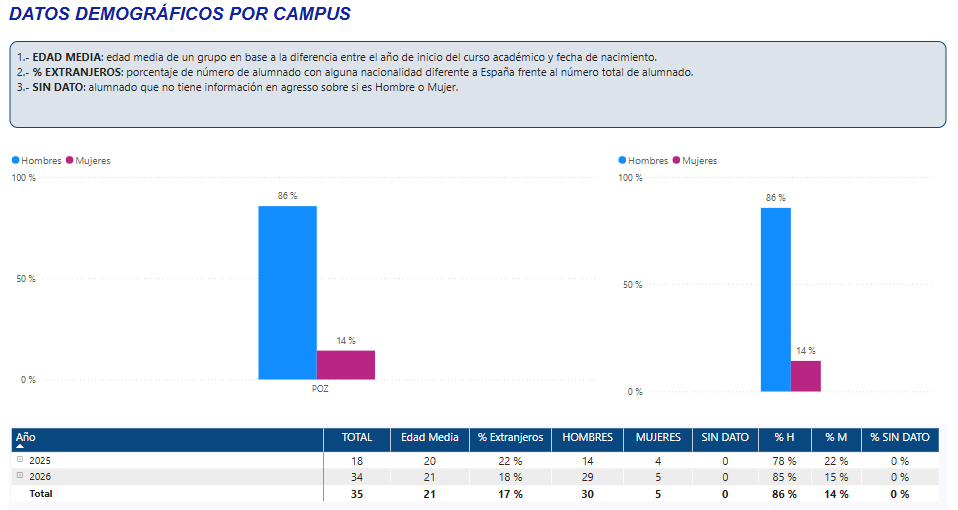
ESIC's quality management system (Blu) shows the students of the Bachelor's Degree in Computer Engineering by sex, which puts women's underrepresentation in the degree in context: in 2025, 4 of its 18 students were women (22%); in 2026, 5 of 34 (15%).
Students of the Bachelor's Degree in Computer Engineering, by sex
| Year | Students | Women | Men | Women (%) |
|---|---|---|---|---|
| 2025 | 18 | 4 | 14 | 22% |
| 2026 | 34 | 5 | 29 | 15% |
WOMEN´S PROGRESS MEASURES
PROTOCOLO DE PREVENCIÓN DE LA DISCRIMINACIÓN: The Law states that the Norms of Coexistence shall establish provisions relating to measures for the prevention of and response to violence, discrimination, harassment or sexual harassment, on grounds of sex, sexual orientation, gender identity or expression, sexual characteristics, national origin, membership of an ethnic group, disability, age, state of health, social class, religion or convictions, language, or any other personal or social condition or circumstance.
Code of ethics: ESIC University promotes the equal participation of people in all its spheres of action, committing itself to non-discrimination for any reason or nature. To this end, it will follow policies of equality that guarantee equal opportunities for all members of its Learning Community and will promote these same principles in its relations with its stakeholders, for the benefit of society as a whole.
PROTOCOLO DE PREVENCIÓN DE LA DISCRIMINACIÓN: The Law states that the Norms of Coexistence shall establish provisions relating to measures for the prevention of and response to violence, discrimination, harassment or sexual harassment, on grounds of sex, sexual orientation, gender identity or expression, sexual characteristics, national origin, membership of an ethnic group, disability, age, state of health, social class, religion or convictions, language, or any other personal or social condition or circumstance.
ESIC University's human resources department shares with the employees the maternity policy that consist in:
This is a paid right that arises due to childbirth, adoption or foster care.
Both the father and the mother are entitled to:
' 6 weeks compulsory, uninterrupted and to be taken on a full-time basis immediately after childbirth.
(the calculation starts from the day of the birth).
10 weeks that can be taken:
- Continuously and accumulated to the compulsory period.
- Interrupted, always in full weeks (7 days).
Full or part-time use of this period will require an agreement between the company and the worker.
In the Student Welcome Document which shows the different options that exist according to each scenario and situation: STUDENT CARE, UNIVERSITY ADVOCATE, STUDENT DEVELOPMENT SUPPORT PLAN AND THE TUTORIA FIGURE. The functions of the different departments are detailed in the student welcome document.
ESIC University considers fundamental, within its educational model, the integral training and support of its students and for this reason has created the figure of the group academic tutor, whose mission is to guide, advise and support the students. This is the figure to whom students should turn to in the first instance when seeking advice.
On the other hand, ESIC University, through its professional development unit, promotes advice and mentoring to support professional development, both one to one, as well as through lectures, etc. as professionals and professional leaders that favour personal and professional growth.
ESIC University measures the participation of both men and women in these services. Both with the monitoring of enrolment and final participation, as well as through the final surveys on each service.
Another programme related to the involvement of women in sustainability is the Mentoring Programme , coordinated by Women Action Sustainability and presented each year at the ESIC University, which aims to mentor students who want to develop their careers in the professional field of sustainability. The mentors are recognised professionals in the field of corporate sustainability.
In addition, the vocational training area works with the Tandem Plan which aims to accompany students in vocational training in their professional development and growth, putting them in contact with different professionals. The mentor collaborates with them through different sessions in their PIP (Individual Professional Plan) and also in the RTW (Ready To Work) online employability course.
ESIC University carries out an exhaustive monitoring of the graduation rates of men and women in all its programmes. This detailed analysis allows us to identify whether there is any gender gap in terms of study completion. Over the last few years, the data shows that there are no significant deviations between the graduation rates of men and women, which demonstrates a balance in terms of academic performance.
| Type | Graduate Men | Graduate Women | Total | % Graduate Women |
|---|---|---|---|---|
| Bachelor | 173 | 124 | 297 | 41,75% |
| Master | 787 | 888 | 1675 | 53% |
| TOTAL | 960 | 1012 | 1972 | 51,31% |
Protection from educational disadvantage:
ESIC University has a solid protocol for the prevention of discrimination and harassment, which protects all members of the university community who report cases of discrimination in the educational environment. This protocol guarantees that no one who reports these situations suffers reprisals or disadvantages in their academic experience. ESIC University promotes a safe and equitable environment, where students can express their concerns without fear of it affecting their academic performance or their chances of progressing in their studies. In addition, personalized support and follow-up measures are implemented for those who report discrimination, ensuring that their educational experience continues without disruption or prejudice.
Protection against employment disadvantages:
In the workplace, ESIC University also guarantees that employees who report cases of discrimination will not face any disadvantages in their working conditions, promotion opportunities or job stability. The university follows strict confidentiality protocols and does not tolerate any kind of retaliation or unequal treatment towards those who report such situations. To this end, confidential reporting and follow-up channels have been established to ensure that people who report discrimination can do so in complete safety and without fear of negative repercussions for their careers within the university.
All of this is covered by ESIC University's general policy of regulatory compliance, its Code of Good Governance and Code of Good Practices , which guarantee an environment of respect and compliance with fundamental rights.
ESIC University's human resources department shares with the employees the maternity policy that consist in:
This is a paid right that arises due to childbirth, adoption or foster care.
Both the father and the mother are entitled to:
' 6 weeks compulsory, uninterrupted and to be taken on a full-time basis immediately after childbirth.
(the calculation starts from the day of the birth).
10 weeks that can be taken:
- Continuously and accumulated to the compulsory period.
- Interrupted, always in full weeks (7 days).
Full or part-time use of this period will require an agreement between the company and the worker.
EMPLOYMENT PRACTICE
ESIC University works to stimulate economic growth in a sustainable way promoting policies that stimulate entrepreneurship and job creation among others, in its commitment to achieving the objectives of SDGs 8: Decent Work and Economic Growth.
XIV State-level collective agreement for university education and research centres: ESIC University declares that it applies the sector collective agreement. The framework in force is the XIV State-level collective agreement for university education and research centres, whose personal scope covers staff with an employment contract at the centres within its scope, with the exclusions expressly provided in its Article 2. The agreement was registered and published in the Official State Gazette (BOE) by the Resolution of 16 May 2024 of the General Directorate of Labour, and it remains in force until 31 December 2027. Its pay is set in the salary tables annexed to the agreement.
Official State Gazette (BOE) · Resolución de 16 de mayo de 2024, XIV Convenio colectivo de ámbito estatal para los centros de educación universitaria e investigación (BOE-A-2024-10663) https://www.boe.es/diario_boe/txt.php?id=BOE-A-2024-10663
ESIC University Annual Report 2022/2023: The Annual Report 2022/2023 of ESIC University states expressly that «ESIC University follows the criteria set by the collective agreement of the education sector». On page 15 the report also describes the administrative and service staff, 68 people all on permanent contracts, and states that the university has a works council that oversees decisions concerning all staff, both administrative and service staff and teaching and research staff.
ESIC University · Memoria Anual 2022/2023 (Annual Report, PDF, page 15) https://www.esic.edu/sites/default/files/2024-09/1920x1080px_Memoria_ESIC_22-23_v3.pdf
Code of Ethics: decent working conditions: ESIC's Code of Ethics states that ESIC guarantees decent working conditions to all its employees, promoting excellence, trust and equal opportunities, and that every action of ESIC and its members shows scrupulous respect for the labour rights recognised in national legislation and in international conventions such as those of the International Labour Organization (section 3.5, page 7). The same section commits ESIC to provide employees with the training they need, to support work-life balance and to prevent occupational risks in order to guarantee health and safety at work. The Code is addressed to ESIC's governing bodies, managers, teaching staff, administrative and service staff, students, alumni and everyone who collaborates with ESIC when acting on its behalf (section 2.3, page 5).
ESIC · Código Ético (Code of Ethics, PDF, sections 2.3 and 3.5, pages 5 and 7) https://www.esic.edu/themes/esic/pdfs/A4_CODIGO_ETICO_ESIC_2022.pdf
Statutory minimum wage and minimum salary paid at ESIC: During 2025 the statutory minimum reference was the national minimum wage (Salario Mínimo Interprofesional, SMI) of €16,576 gross a year for a full-time working day, or the proportional amount for part-time work. At ESIC the minimum salary paid to employees is €21,000 a year.
Statutory minimum wage and minimum salary paid at ESIC
| Reference | Amount per year |
|---|---|
| Statutory minimum wage (SMI), 2025, full-time working day | €16,576 gross |
| Minimum salary paid to ESIC employees | €21,000 |
ESIC · internal salary record. Figures given on this page.
Social Responsibility page: pay above the agreement: ESIC's Social Responsibility page, in its section on SDG 8, states that ESIC pays all its employees, in all categories, the basic salary and supplements above the agreement. The same section refers to the Merco Empresas ranking, which included ESIC among the companies with the best reputation and the greatest capacity to attract and retain talent, thanks to the evaluations of employees among others; one of the questions in that report is whether employees consider that they receive a salary consistent with the function performed.
ESIC · Responsabilidad Social (Social Responsibility page, section «Employment practice») https://www.esic.edu/institucion/responsabilidad-social-esic
III Equality Plan: joint negotiating and monitoring committees: ESIC has mechanisms for dialogue and negotiation with the legal representation of its workers. The III Equality Plan documents that it was drawn up by a joint negotiating committee of the company and the staff representation, and that a Monitoring and Evaluation Committee with the same participation exists. The plan applies to all ESIC staff at its workplaces in Spain. These mechanisms show institutional dialogue with the representatives of the workers.
ESIC · III Plan de Igualdad (III Equality Plan), signed document published in REGCON, the Spanish register of collective agreements, collective labour agreements and equality plans.
Works council and the right of association: ESIC's Social Responsibility page states that ESIC recognises the right of association of all workers, including international and women staff. It adds that an Electoral Board is established, as provided for in Article 73 of the Workers' Statute, to promote elections for a works council at the request of the workers; that the works council meets periodically, as Article 63 provides, and its proposals and resolutions are reported through different channels; and that any employee can contact it at comite.empresa@esic.edu. The Annual Report 2022/2023 (page 15) confirms that ESIC University has a works council that oversees decisions concerning all staff, both administrative and service staff and teaching and research staff, and holds a continuous dialogue with the workers' representatives to improve working conditions and staff rights. In Madrid, where ESIC has a works council, staff can also raise their questions through it; in the other centres, which have no union representation of their own, negotiations are held with the unions that are most representative in the sector.
ESIC · Responsabilidad Social (Social Responsibility page, section «Employment practice», point 2) https://www.esic.edu/institucion/responsabilidad-social-esic
ESIC University · Memoria Anual 2022/2023 (Annual Report, PDF, page 15) https://www.esic.edu/sites/default/files/2024-09/1920x1080px_Memoria_ESIC_22-23_v3.pdf
Workers' Statute, Article 4: basic labour rights: Spanish law backs these rights. Article 4.1 of the Workers' Statute, in the consolidated text published by the Official State Gazette (BOE), lists among the basic rights of workers free union membership, collective bargaining, the adoption of collective-conflict measures, strike, assembly, and information, consultation and participation in the company.
Official State Gazette (BOE) · Real Decreto Legislativo 2/2015, texto refundido de la Ley del Estatuto de los Trabajadores (Workers' Statute, consolidated text), Article 4 https://www.boe.es/buscar/act.php?id=BOE-A-2015-11430
Specific Corporate Diversity Policy: ESIC has a Specific Corporate Diversity Policy, part of its General Corporate Sustainability Policy, which establishes non-discrimination in the workplace and applies expressly to administrative and service staff and to teaching and research staff. The policy guarantees non-discrimination on grounds of sex, age, religion, conviction or opinion, sexual orientation or identity, racial, ethnic or geographical origin, disability and any other personal or social condition or circumstance. It also promotes equal opportunities, equitable treatment and the cross-cutting management of diversity in people management and in ESIC's teams. On pages 10 and 11 of the policy, the first principle guarantees that no member of the ESIC community is discriminated against on those grounds, among others; the second promotes equal opportunities and equitable treatment for everyone who works or studies at the institution; the fourth commits ESIC to build a diverse workforce with a balanced presence of men and women in the different decision-making bodies and organisational levels; the seventh requires diversity management to be a cross-cutting practice in people management, within any team; and the ninth promotes work-life balance. The policy is drawn up by the Sustainability Department in consultation with Human Resources, reviewed by Corporate Reputation and approved by the Management Committee, and it is reviewed every year.
ESIC · Política General Corporativa de Sostenibilidad, Política Corporativa Específica de Diversidad (General Corporate Sustainability Policy, PDF, pages 10 and 11) https://www.esic.edu/sites/default/files/2024-11/09%20POLITICA%20CORPORATIVA%20DE%20SOSTENIBILIDAD.pdf
Code of Ethics: discrimination, harassment and the Ethics Channel: This framework is complemented by the Code of Ethics, which rejects any kind of discrimination and harassment in both the professional and the academic sphere and establishes respect for human and labour rights (sections 3.5 to 3.7, page 7). To supervise compliance, the Code creates an Ethics Committee, made up of the General Secretariat, the Sustainability Department, the Human Resources Department and three experts, one each from ESIC University, ESIC Business School and ESIC Escuela Superior de Ciclos, and a confidential Ethics Channel to ask questions or report possible breaches, at canaletico@esic.edu (section 4.2, pages 9 and 10). Every complaint made in good faith is treated confidentially and the person who made it is protected; a manifestly false complaint or one made in bad faith may lead to disciplinary proceedings (section 4.3, page 10). Conduct contrary to the Code may be subject to disciplinary sanction under the internal regulations, and, where it also constitutes an infringement, the applicable sanctioning rules apply (section 4.4, page 10).
ESIC · Código Ético (Code of Ethics, PDF, sections 3.5 to 3.7 and 4.2 to 4.4, pages 7 and 9 to 10) https://www.esic.edu/themes/esic/pdfs/A4_CODIGO_ETICO_ESIC_2022.pdf
Commitment on Ethical and Legal Compliance: ESIC has a Commitment on Ethical and Legal Compliance that applies to its contractual and collaborative relations. In its section «Corporate Social Responsibility (RSC–ESG)», on page 2, the document states expressly that the parties respect the labour and union rights of their workers, do not use child labour and reject any kind of forced labour. It also prohibits any kind of discrimination and requires compliance with occupational risk prevention law and the protection of workers' safety. These commitments are incorporated into relations with ESIC through the contracts or agreements signed with ESIC or through their acceptance or a separate communication (point 4, page 1). The document is dated January 2025 (version V.2025.01) and is published on esic.edu both as a web page and as a PDF.
ESIC · Compromiso sobre Cumplimiento Ético y Legal, apartado «Responsabilidad Social Corporativa (RSC–ESG)» (Commitment on Ethical and Legal Compliance, web page) https://www.esic.edu/institucion/compromiso-de-cumplimiento
ESIC · Compromiso sobre Cumplimiento Ético y Legal, enero de 2025 (same commitment, PDF, page 2) https://www.esic.edu/themes/esic/pdfs/ESIC_COMPLIANCE_2025.01.pdf
Code of Ethics: international commitments on human and labour rights: ESIC's Code of Ethics states that ESIC is a signatory of the United Nations Global Compact and of the Principles for Responsible Management Education (PRME), and that it is committed to respect for all human rights and labour rights (section 1.3, pages 4 and 5). It adds that every action of ESIC and its members shows scrupulous respect for human rights and public freedoms, such as those in the Universal Declaration of Human Rights, and for the labour rights recognised in national legislation and in international conventions, such as those of the International Labour Organization (section 3.5, page 7).
ESIC · Código Ético (Code of Ethics, PDF, sections 1.3 and 3.5, pages 4, 5 and 7) https://www.esic.edu/themes/esic/pdfs/A4_CODIGO_ETICO_ESIC_2022.pdf
Commitment on Ethical and Legal Compliance: ESIC sets obligations to protect labour rights in its relations with third parties through the Commitment on Ethical and Legal Compliance, which applies to its contracts and agreements. Point 2 of the document (page 1) states that all workers affected by the contract or agreement, whether own or subcontracted staff and equivalent personnel, will know ESIC's Code of Ethics, which the parties must follow. In its section on Corporate Social Responsibility (page 2), the parties declare that they respect the labour and union rights of their workers, do not use child labour, reject any kind of forced labour, prohibit any kind of discrimination, comply with occupational risk prevention law and ensure the safety of their workers. Point 3 (page 1) commits the parties, for the duration of the contracts and the limitation period that follows, to keep their own policies and procedures to ensure ethical compliance and to give reasonable assurance that breaches will be prevented, detected and remedied, to inform each other without delay of any breach, to check each other's compliance and to cooperate fully in any audit, review or investigation. Under the heading «Contravención de lo acordado» (page 2), a breach allows the other party to terminate the contract or agreement unilaterally without penalty.
ESIC · Compromiso sobre Cumplimiento Ético y Legal, enero de 2025 (Commitment on Ethical and Legal Compliance, PDF, pages 1 and 2) https://www.esic.edu/themes/esic/pdfs/ESIC_COMPLIANCE_2025.01.pdf
ESIC · Compromiso sobre Cumplimiento Ético y Legal (same commitment, web page) https://www.esic.edu/institucion/compromiso-de-cumplimiento
III Equality Plan: equal pay, pay audit and pay register: ESIC's III Equality Plan sets the commitment to guarantee equal pay between women and men for work of equal value and the absence of discrimination on grounds of sex in working conditions. To measure and assess pay equity, the Plan provides for a job valuation, a pay audit and the annual preparation of a pay register, under the responsibility of the Human Resources Department. The document states that a pay audit was carried out as part of the diagnosis and includes, among its indicators for monitoring the pay gap, the average annual pay, fixed and variable, of women and men in posts of equal value. Monitoring and evaluation correspond to a joint committee of the company and the staff representation, whose functions include preparing annual monitoring reports and interim and final evaluations, and proposing corrective measures where appropriate. ESIC's Equality Plan is published in REGCON, the register and deposit of collective agreements, collective labour agreements and equality plans.
ESIC · III Plan de Igualdad (III Equality Plan), signed document published in REGCON, the Spanish register of collective agreements, collective labour agreements and equality plans.
Workers' Statute, Article 28: equal pay for women and men: ESIC declares that it applies Article 28 of the Workers' Statute on equal pay. Under that article, the employer must pay the same remuneration for work of equal value, whatever its nature, salary or non-salary, without discrimination on grounds of sex in any element or condition of it (Article 28.1). It also obliges the employer to keep a record of the average values of salaries, salary supplements and non-salary payments of its workforce, broken down by sex and by professional groups, categories or posts of equal value, to which workers have the right of access through their legal representatives (Article 28.2).
Official State Gazette (BOE) · Real Decreto Legislativo 2/2015, texto refundido de la Ley del Estatuto de los Trabajadores (Workers' Statute, consolidated text), Article 28 https://www.boe.es/buscar/act.php?id=BOE-A-2015-11430
Social Responsibility page: equal pay and the Equality Plan diagnosis: ESIC's Social Responsibility page, in its section on SDG 8, states under the heading on pay scale equity that ESIC applies existing state policies on equal pay for men and women and also applies Article 28 of the Workers' Statute, «Equal pay for men and women». It adds that the Equality Plan has a diagnosis to measure salary deviations, and that ESIC gives visibility, through events and webinars, to the professional gaps between men and women, for example with the conference held to present the GERDERCOM report «Salary gap, glass ceiling and stress: an x-ray of women in the communication sector».
ESIC · Responsabilidad Social (Social Responsibility page, section «Employment practice», point 6) https://www.esic.edu/institucion/responsabilidad-social-esic
Social Responsibility page: tracking pay equity: ESIC's Social Responsibility page, in its section on SDG 8, states under the heading «ESIC tracks pay scale gender equity» that ESIC reports to MERCO the salary bands of its workers, which make no distinction based on gender, as well as other data on working conditions. It adds that there is wage equality without distinction according to gender, that wages are classified according to position and category, and by academic level in the case of the teaching staff, and that the Equality Plan has a diagnosis to measure salary deviations, in which positive and negative discrimination has been measured.
ESIC · Responsabilidad Social (Social Responsibility page, section «Employment practice», point 7) https://www.esic.edu/institucion/responsabilidad-social-esic
III Equality Plan: pay audit, pay register and monitoring committee: The III Equality Plan documents that a pay audit and a job valuation were carried out as part of the diagnosis. It also provides for the annual preparation of a pay register, under the responsibility of the Human Resources Department. Among the indicators for monitoring the pay gap, it includes the average annual pay, fixed and variable, of women and men in posts of equal value, which makes it possible to compare remuneration and identify possible differences. The Monitoring Committee of the Equality Plan has among its functions to assess the measures and to prepare annual monitoring reports, and to propose corrective measures where appropriate.
ESIC · III Plan de Igualdad (III Equality Plan), signed document published in REGCON, the Spanish register of collective agreements, collective labour agreements and equality plans
Mailboxes for payroll and labour-rights questions: ESIC has channels for workers to raise queries, incidents and complaints about their labour rights and their pay. For any question about payments, the address nominas@esic.edu is maintained by Human Resources; for any question about employee rights or another issue, the address is rrhh@esic.edu. ESIC's Social Responsibility page also mentions a direct channel with the quality department to report any incident, doubt or question that administrative or academic staff may have regarding their labour rights.
ESIC · Responsabilidad Social (Social Responsibility page, section «Employment practice», point 8) https://www.esic.edu/institucion/responsabilidad-social-esic
Works council: In Madrid, where ESIC has a works council, workers can also pass on doubts and suggestions through this body, at comite.empresa@esic.edu. This route is not presented as a representation mechanism existing in every centre: in the other centres, which have no union representation of their own, negotiations are held with the most representative unions of the sector. The Annual Report 2022/2023 of ESIC University, on page 15, confirms the existence of the works council for administrative and service staff and for teaching and research staff, and its dialogue on working conditions and staff rights: the works council oversees decisions concerning all staff and holds a continuous dialogue with the workers' representatives to improve working conditions and staff rights, ensuring participatory and equitable management. ESIC's Social Responsibility page adds that the works council's proposals and resolutions are reported through different channels and that employees can send their doubts and suggestions so that they are heard by the board of directors.
ESIC University · Memoria Anual 2022/2023 (Annual Report, PDF, page 15) https://www.esic.edu/sites/default/files/2024-09/1920x1080px_Memoria_ESIC_22-23_v3.pdf
ESIC · Responsabilidad Social (Social Responsibility page, section «Employment practice», point 8) https://www.esic.edu/institucion/responsabilidad-social-esic
Internal Information System: procedure of February 2023: As a complementary route, when the facts may constitute a breach of regulations, ESIC has an Internal Information System. Communications can be submitted directly to the Regulatory Compliance Department or through the channels enabled on the intranet and the institutional website. The Procedure of the Internal Information System on Regulatory Compliance, edition 1 of 21 February 2023, adapted to Law 2/2023, sets out the stages and the guarantees of the compliance channel. Any member of ESIC may report verbally or in writing to a hierarchical superior, who must receive it and pass it on to the Compliance Department respecting the reporter's anonymity (pages 7 and 8), or directly to the Compliance Department, by email or through the web form (pages 8 and 9). A communication may be anonymous; if it is not, the Compliance Department keeps it confidential. The procedure provides for the registration of the communication with a file number, an acknowledgement of receipt within a maximum of 7 days, anonymisation of the data and classification of the communication (pages 15 and 16), preliminary inquiries and, where there is sufficient evidence, an internal investigation; the investigation and the reply to the reporter may not take more than three months, extendable by up to three more in complex cases (page 18). The procedure also sets the principles of confidentiality and of protection of the reporting person under the anti-retaliation rules (page 7). This system complements the labour and pay channels, without replacing them.
ESIC · Procedimiento del Sistema Interno de Información en materia de Cumplimiento Normativo, edición del 21 de febrero de 2023 (Internal Information System procedure, PDF, pages 7 to 9, 15, 16 and 18) https://www.esic.edu/sites/default/files/2023-05/procedimiento.pdf
ESIC · Sistema interno de información (web page) https://www.esic.edu/institucion/sistema-interno-de-informacion
Institutional statement and Code of Ethics: ESIC's Social Responsibility page states under the heading «ESIC recognises unions and labour rights of all workers» that ESIC recognises the right of association of all workers, including international and women staff. It adds that an Electoral Board is established, as provided for in Article 73 of the Workers' Statute, to promote elections for a works council at the request of the workers, and that the works council meets periodically. The Code of Ethics establishes respect for labour rights (section 3.5, page 7), equality of opportunities and non-discrimination (section 3.7, page 7). In Madrid, ESIC has a works council as a body representing the workers; in the other centres, which have no union representation of their own, negotiations are held with the most representative unions of the sector. The absence of union representation of its own in a centre does not limit the recognition of the rights of association and collective bargaining of its staff.
ESIC · Responsabilidad Social (Social Responsibility page, section «Employment practice», point 2) https://www.esic.edu/institucion/responsabilidad-social-esic
ESIC · Código Ético (Code of Ethics, PDF, sections 3.5 and 3.7, page 7) https://www.esic.edu/themes/esic/pdfs/A4_CODIGO_ETICO_ESIC_2022.pdf
Workers' Statute, Articles 4 and 17 and Title III: This recognition is developed within the framework of the Workers' Statute. Article 4 sets out the rights to free union membership, collective bargaining, assembly and participation in the company. Article 17 prohibits discrimination in labour relations. Title III regulates collective bargaining and collective agreements.
Official State Gazette (BOE) · Real Decreto Legislativo 2/2015, texto refundido de la Ley del Estatuto de los Trabajadores (Workers' Statute, consolidated text), Articles 4 and 17 and Title III https://www.boe.es/buscar/act.php?id=BOE-A-2015-11430
XIV State-level collective agreement for university education and research centres: On collective bargaining, ESIC declares that it applies the sector collective agreement. The reference framework is the XIV State-level collective agreement for university education and research centres, which regulates the working conditions of the staff within its scope. It was registered and published in the Official State Gazette (BOE) by the Resolution of 16 May 2024 of the General Directorate of Labour, it is of direct application throughout Spain (Article 1) and it remains in force until 31 December 2027 (Article 3).
Official State Gazette (BOE) · Resolución de 16 de mayo de 2024, XIV Convenio colectivo de ámbito estatal para los centros de educación universitaria e investigación (BOE-A-2024-10663) https://www.boe.es/diario_boe/txt.php?id=BOE-A-2024-10663
MEASURES AGAINST DISCRIMINATION
ESIC University works to stimulate economic growth in a sustainable way promoting policies that stimulate entrepreneurship and job creation among others, in its commitment to achieving the objectives of SDGs 8: Decent Work and Economic Growth.
Admissions process and Diversity Project: ESIC University runs a transparent and objective admissions process, based on academic requirements and on criteria linked to the programme applied for: the entry qualification, a personal interview, a case study and a language-level assessment. The process is set within the institutional framework of ESIC's Diversity Project, which formally guarantees equal opportunities and non-discrimination in access to education on grounds of gender, race, origin, religion or functional diversity, and seeks to remove barriers in education. ESIC's admissions page describes the admission test, which lasts about an hour and a half, needs no previous preparation and has four parts: a personal interview about the candidate's profile, affinity with the chosen degree and motivation; a practical or business case that assesses writing, reasoning and expression rather than subject knowledge; and oral and written tests of English and Spanish, which candidates with a recent official certificate do not need to take. ESIC Universidad's Undergraduate Admissions Regulations state that admission is carried out on equal terms for all the places offered, regardless of the candidate's district of origin or place of residence (page 2), and that ESIC Universidad reserves 5% of its places for students with disabilities, 3% for high-level and high-performance athletes and 1% for university graduates (page 6). The Diversity Project page states the project's aim: to offer training and social and labour inclusion to everybody, and especially to those who are discriminated against because of their gender, race, origin, religion or functional diversity (accredited as 33% or more).
Proceso y requisitos de admisión: https://www.esic.edu/en/degrees/admissions-and-grants
Proyecto de Diversidad y compromiso de no discriminación en el acceso: https://www.esic.edu/en/institution/diversity-project-esic-business-marketing-school
Diversity Scholarships: As a specific positive discrimination measure to promote equal opportunities and inclusive access, ESIC offers Diversity Scholarships. The programme reduces tuition fees directly, according to the degree of disability, for students with an officially recognised disability of 33% or more. ESIC's Diversity Programme page gives the reasoning: talent knows no barriers, and the scholarship aims to open education to people who bring diversity to the educational community, promoting equal opportunities and their academic, professional and personal development in an inclusive and accessible environment. It is open to anyone who officially accredits a degree of disability of 33% or more and has been admitted to a higher vocational training, bachelor's, master's or MBA programme at ESIC, and it is applied to tuition only.
Diversity Scholarship as a share of tuition, by accredited degree of disability
| Programme | 33% | Over 33% to 65% | Over 65% |
|---|---|---|---|
| Higher vocational training | 10% | 20% | 30% |
| Bachelor's degrees | 10% | 20% | 30% |
| Master's and MBA | Up to 30% | Up to 40% | 50% |
https://www.esic.edu/institucion/sostenibilidad/programa-diversidad
Diversity Attention Unit: ESIC University has a Diversity Attention Unit that gives continuous support to students with specific educational support needs and functional diversity, guaranteeing institutional accessibility and comprehensive support throughout their studies. Its page sets as its first objective making all the academic, technical or operational adaptations needed to guarantee access, inclusion, active participation in the university community and accessibility, inside and outside the classroom. Each student agrees an Individual Action Plan (PAI) with the person responsible for diversity at ESIC University, bringing up-to-date medical reports, and the process is repeated every year. The Unit follows a specific procedure with technical and organisational security measures to protect the privacy of the people it serves.
https://www.esic.edu/university/sostenibilidad/unidad-de-atencion-diversidad
Students with disabilities: application data and yearly census: ESIC University tracks and monitors the profile of its students from the admission application stage to their actual enrolment, which makes it possible to identify and measure the presence of specific and under-represented groups. For functional diversity and students with disabilities, the application process for the Diversity Scholarships and the official accreditation of disability (33% or more) allow the institution to record and monitor the number of candidates and admitted students with functional diversity, so that their access and inclusion measures can be coordinated. ESIC's General Policy of the Support Programme for students with functional diversity or special educational needs gives this tracking a formal basis. The Technical Unit for Diversity must draw up and keep up to date a census of students with functional diversity and special educational needs (article 4, page 4). Every year a census is compiled from the self-declaration data given at enrolment, and once enrolment closes the General Secretariat provides the list of these students so that the measures needed can be planned (article 9, page 5). For candidates who ask for adapted entrance tests, the admissions officer tells the Unit which of them have been admitted and which have not (annex I, step 05, page 9).
Gender, origin and nationality in the admission application: Through the official admission form and the candidates' files, ESIC University tracks the demographic profile of candidates by gender and by origin or nationality, ensuring non-discrimination and assessing the diversity of the student body across its degrees and programmes. The undergraduate admission application form (SOL-86-E) collects, for every candidate, sex, date of birth, country of birth and up to two nationalities. It also asks whether the candidate has a disability, of what type (physical, psychological, sensory or intellectual) and degree, or special educational needs; in that case the Technical Unit for Diversity contacts the candidate to study any adaptation needed during admission. ESIC's admissions page sets out the process every candidate follows, from the appointment for the admission test to enrolment. https://www.esic.edu/en/degrees/admissions-and-grants
https://www.esic.edu/institucion/sostenibilidad/programa-diversidad
Diversity Project: identifying barriers: Through ESIC's Diversity Project, the institution commits to identifying barriers and following up the people who may face discrimination on grounds of gender, origin or functional diversity, ensuring fair access to university education. The project page states that the DUE (Diversity University-Company) Diversity Project sets up an organisational structure, procedures, policies and adequate resources to develop action plans every year, integrated into the School's Quality Policy; that it is national in scope; and that it is directed by ESIC's General Secretary, who is responsible for its monitoring, review and proposals for improvement.
https://www.esic.edu/en/institution/diversity-project-esic-business-marketing-school
Diversity Scholarships for master's and MBA programmes: For students with functional diversity, ESIC University calls the Diversity Scholarships every year. They reduce academic fees by 30%, 40% or 50%, according to the official degree of disability (33% or more), to remove economic barriers to university and postgraduate studies. ESIC's scholarships page for master's and postgraduate programmes sets the amounts for any ESIC master's or MBA programme nationwide: up to 30% of tuition for a disability of 33%, up to 40% for a disability between 33% and 65%, and up to 50% for a disability above 65%. Candidates must first pass the admission process, and the Diversity Committee communicates the decision. For bachelor's degrees and higher vocational training, ESIC's Diversity Programme page gives 10%, 20% and 30% of tuition for the same bands.
https://en.esic.edu/master-and-postgraduate/scholarships-and-grants
Women + Leadership Scholarship: For women in management education, ESIC calls the Women + Leadership Scholarship, a specific grant of 50% of tuition to promote the entry and representation of women with professional potential in postgraduate and executive master's programmes (Full-Time MBA, International MBA, Executive MBA and Global MBA). ESIC's scholarships page presents it as part of the Diversity Project of ESIC Business & Marketing School, which supports the contribution of women in the professional world. The scholarship is national in scope and is awarded on the candidate's academic record, professional experience, financial resources, languages and volunteering.
https://www.esic.edu/sites/default/files/2025-03/Folleto%20Becas%20y%20Ayudas%202024-25.pdf
Diversity Project and scholarships for under-represented groups: ESIC's Diversity Project brings these actions together with the aim of reducing barriers to higher education on grounds of gender, origin or functional diversity. ESIC University's Diversity Program page lists the measures it manages for the students in the programme, among them adaptation of the entrance exams, welcome and orientation procedures for new students, scholarships and grants, and physical, technical and operational accessibility. The 2026/2027 scholarship brochure adds other calls aimed at under-represented groups: a STEM Women scholarship, exclusive to the Bachelor's Degree in Computer Engineering and run with Microsoft, to reduce the gender gap in science, technology, engineering and mathematics (page 17); a single-parent family scholarship (page 16); and an international mobility scholarship for students whose family home is outside Spain (page 10).
https://en.esic.edu/university/sostenibilidad/programa-diversidad
Global Campus: Through ESIC University's Global Campus, ESIC promotes recruitment and welcome actions aimed at bringing in students, faculty and researchers from diverse cultural and geographical backgrounds, building a diverse and global university community. The Global Campus page makes it the fourth axis of ESIC University's international strategy, with two stated aims: to attract and support a diverse and talented pool of international students, and to attract and retain a diverse and talented pool of international professors. It also provides for a welcome desk and orientation programmes for international students, and for support services that include language training, academic advising and career development.
https://www.esic.edu/en/university/international/global-campus
Protocol on discrimination, violence and harassment: ESIC University has a public, institutional and binding protocol that sets out the measures to prevent, detect and act on any discrimination, violence or harassment in the university community, and applies to students, faculty and staff. It expressly prohibits discrimination on grounds of sex, sexual orientation, gender identity or expression, sexual characteristics, national or ethnic origin, disability, age, health, social class, religion, beliefs, language or any other personal or social circumstance, and it defines the specific procedure to report, process and resolve these situations. The full text, the Protocol for the prevention of and procedure for action in cases of violence, discrimination or harassment in the university community, was approved by the Board of Trustees on 20 February 2023 and applies from the 2022-2023 academic year with no end date. It covers students, teaching and research staff and administrative and service staff, whatever their legal relationship with the University, and also people who work at ESIC University for contractors, subcontractors or temporary work agencies (article 3). Its procedure follows the principles of speed, confidentiality, protection of privacy and dignity, legal certainty and protection against reprisals (article 5), and a complaint must be resolved within 30 working days (article 7).
https://www.esic.edu/university/protocolo-prevencion
Social Responsibility Policy: ESIC's Corporate Social Responsibility Policy sets the institutional ethical framework to prevent and reject any discriminatory practice or harassment towards all its stakeholders (students, teaching staff, administrative and service staff). It includes a formal commitment to equal treatment, non-discrimination (on grounds of race, ethnicity, sexual orientation, religion, gender or disability) and the promotion of inclusive and fair environments. ESIC's Social Responsibility page quotes the policy: ESIC is a higher education institution «against any kind of discrimination and harassment in relation to all its stakeholders»; it gives access to everyone who meets the academic prerequisites and «is committed to not discriminate against students on the basis of race, sexual orientation, ethnicity, religion, disability or gender or any other legally protected factor»; and it guarantees and promotes the equal admission and participation of men and women, both students and teaching and administrative staff.
https://www.esic.edu/sites/default/files/2020-11/rsc-esic.pdf
Diversity Charter: ESIC has signed the Diversity Charter, publicly taking on its ten basic principles on equal opportunities, respect for diversity and the elimination of direct and indirect discrimination at work and in education. ESIC's news item of October 2022 reports that ESIC signed the Charter on 19 July and lists the ten principles. They include building a diverse workforce regardless of gender, sexual orientation, race, nationality, ethnic origin, religion, beliefs, age, disability or any other personal or social circumstance (principle 2), and promoting inclusion by avoiding any direct or indirect discrimination at work (principle 3).
https://www.esic.edu/noticias/esic-firma-la-carta-de-diversidad-y-asume-los-10-principios-basicos
Technical Unit for Diversity: ESIC University has the Technical Unit for Diversity (UTD), the operational and specialised structure in charge of coordinating, advising on and implementing inclusion, equity and accessibility policies on campus. Its main functions are advice and adaptations, with the individual coordination of curricular, methodological and technical adaptations for students with functional diversity and specific educational support needs; training and awareness on campus, with awareness days and training programmes for the university community to promote accessible environments free of discrimination; and support for the whole community, with a direct channel of guidance and support not only for students but also for teaching and management staff with functional diversity (diversidad@esic.edu). The Diversity Project page places the Unit within the DUE (Diversity University-Company) Diversity Project, which has an organisational structure, procedures, policies and resources to develop action plans every year within the Quality Policy, is national in scope and is directed by ESIC's General Secretary, responsible for its monitoring, review and proposals for improvement. The Unit coordinates with every ESIC area and department the actions needed to meet specific needs, and teachers, management staff and collaborators with functional diversity can contact it directly. Its functions are set in article 4 of ESIC's General Policy of the Support Programme for students with functional diversity or special educational needs: advising candidates and students on the resources available, keeping a census, handling individual requests, producing information and guidance materials, following up the services students receive, and raising awareness across the whole community.l (diversidad@esic.edu).
https://www.esic.edu/institucion/sostenibilidad/unidad-de-atencion-diversidad
https://www.esic.edu/institucion/proyecto-diversidad-esic-business-marketing-school
Equality Plan Monitoring and Evaluation Committee: As a governance and oversight body for equal opportunities and non-discrimination, ESIC has a joint committee made up of representatives of the institution and of the workers (teaching and administrative staff). It is formally tasked with periodically monitoring the implementation of the Equality Plan measures, evaluating the degree to which the objectives and commitments on equal treatment are met, and overseeing training, work-life balance and bias-prevention actions at work and in teaching. The III Equality Plan states that its monitoring and evaluation are carried out by the Equality Plan Monitoring Committee, a joint body of company and staff representatives formed by the same members who negotiated the Plan. Its main purpose is to follow up the implementation of the measures in the Plan and to evaluate how far the Plan, its objectives and its actions are fulfilled (page 23 of the PDF).
https://www.esic.edu/university/sostenibilidad
Published in REGCON: "FUNDACIÓN DE ESTUDIOS SUPERIORES E INVESTIGACIÓN ESIC" https://expinterweb.mites.gob.es/regcon/pub/consultaPublicaEstatal.
Buddy Program: ESIC University runs the Buddy Program, coordinated by the International area, which connects incoming international students directly with local students. The programme provides a structured peer-support network that helps with welcome, cultural adaptation, orientation on campus and the academic and social integration of students who face language or cultural barriers when joining the Spanish university system. ESIC's programme page explains that each international student is assigned a Buddy, always a third-, fourth- or fifth-year student with international mobility experience, languages and a vocation for welcoming, matched by studies, interests and languages, and that a new Buddy can be assigned if the match does not work. Buddies help with academic questions and with life in Spain, from finding classrooms and the library to public transport, accommodation and health services, and the International Department organises activities for international students and buddies. ESIC University's page for incoming students adds that the programme runs for a semester or an academic year as an initiative from students to students, with the support of the Vice-Rectorate for International Relations, and that each Buddy can support at least four international students.
https://www.esic.edu/en/international/boarding-esic/buddy-program
(or the university version: https://www.esic.edu/university/internacional/estudiantes/incoming-students
Diversity Attention Unit: counselling, individual plans and peer support: Through the Diversity Attention Unit and the Diversity Programme, ESIC University offers comprehensive counselling and continuous follow-up for under-represented groups. For students with functional diversity and specific educational support needs, it draws up Individual Action Plans, adapts methods and assessment and gives personal guidance to ensure their full academic and social inclusion, and it also promotes voluntary peer-collaboration networks as support in class. It has a specific employment and internship advice channel, run with companies, for students and alumni with disabilities (empleo.diversidad@esic.university). And it gives teaching and management staff continuous training and technical advice on inclusion guidelines, adaptations and attention to diversity. The Unit's page adds that the employment service works with special employment centres and ordinary companies and is open to students in the last two years of a bachelor's degree, master's students, recent graduates and alumni, and that teaching, research and administrative staff have a guide of general measures for students with specific educational support needs, the adaptation guide of the SAPDU network and a guide to behavioural patterns. The Diversity Project page invites ESIC students to collaborate with the project by supporting a fellow student who has suffered discrimination, has a functional diversity or has special educational needs. ESIC's General Policy of the Support Programme provides for a tutor, designated on every campus with students in the programme, who keeps a system of personalised tutorials (article 14, pages 6 and 7).
ESIC University · Unidad de Atención a la Diversidad (Diversity Attention Unit page) https://www.esic.edu/university/sostenibilidad/unidad-de-atencion-diversidad
ESIC · Programa Diversidad (Diversity Programme page) https://www.esic.edu/institucion/sostenibilidad/programa-diversidad
ESIC · Diversity Project https://www.esic.edu/en/institution/diversity-project-esic-business-marketing-school
ESIC · Política General del Programa de apoyo al alumnado con diversidad funcional o necesidades educativas especiales (General Policy of the Support Programme for students with functional diversity or special educational needs, PDF, edition 1 of 21 September 2018, article 14, pages 6 and 7) https://www.esic.edu/pdf/politica_apoyo_discapacidad_edicion1.pdf
Welcome manual: The university gives students and the university community welcome guides and manuals that gather the institutional channels of psycho-educational support, tutoring and guidance available from the first day. ESIC's 2022-2023 Welcome Manual describes, on page 35, the services of its diversity unit for students with special educational needs or disabilities: easier access to education, individual day-to-day advice and academic adaptations in teaching, learning and assessment, accessibility in the centre and the classroom, Diversity Scholarships and a specialised employability service. It also invites students who want to act as student guides, helping fellow students who need support, to contact the unit. https://www.esic.edu/sites/default/files/2022-11/manual_bienvenida_22_23.pdf
Accessibility in the disability support policy: ESIC has a Policy to support people with disabilities that formalises the institutional commitment to universal design and the continuous removal of architectural barriers on its campuses and facilities. It covers the removal of physical barriers and the continuous maintenance of accessibility in entrances, interior routes, ramps and lifts, so that people with physical and motor disabilities can move independently; parking spaces reserved for people with reduced mobility; adaptation and accessibility of common areas, teaching spaces and catering services; and adapted information and communication channels. Article 13 of ESIC's General Policy of the Support Programme for students with functional diversity or special educational needs commits ESIC to promote independent living and universal accessibility. Accessibility criteria are supervised continuously, and reports on architectural barriers are issued that include a study of the campuses and centres and the most urgent solutions. Every campus reserves enough parking spaces for members of the university community with reduced mobility, signposted under current regulations and controlled so that unauthorised vehicles do not use them. The catering services are adapted so that people with functional diversity can use the restaurant and its services, and ESIC ensures the best possible access to information and communication (page 6).
https://www.esic.edu/pdf/politica_apoyo_discapacidad_edicion1.pdf
Accessible buildings on campus: ESIC University's facilities and teaching spaces are designed to guarantee free movement and full participation for people with functional diversity. The buildings have step-free access or standard ramps, lifts between all floors, and accessible routes to classrooms, the library and common areas.
https://www.esic.edu/pdf/politica_apoyo_discapacidad_edicion1.pdf
https://www.esic.edu/university/campus
Individual adaptation of spaces and resources: Through the Diversity Attention Unit, ESIC University coordinates the provision of specialised resources and the individual adaptation of spaces and technical means in the classroom according to the specific needs of students with functional diversity (priority seating, adapted furniture or assistive technology for learning). The Unit's page sets as its first objective making the academic, technical or operational adaptations needed to guarantee access, inclusion, active participation and accessibility for students with functional diversity or special educational needs, both inside and outside the classroom. The Diversity Programme page lists physical, technical and operational accessibility among the measures the Unit manages, and states that students in the programme can ask it for any physical, technical or academic help.
https://www.esic.edu/institucion/sostenibilidad/unidad-de-atencion-diversidad
Individual Action Plan: Through ESIC University's Diversity Attention Unit, the specific needs of students with functional diversity and special educational needs are assessed individually, in order to design and carry out an Individual Action Plan. The plan includes personal and technical support resources (management and coordination of accessibility assistance inside and outside the classroom, operational adaptations, and provision of technical or human support according to each profile's needs); academic and assessment adaptations (adjusted times, exam formats, teaching materials and seating in the classroom); and guidance for staff (guidelines and protocols for teaching and administrative staff so that care is appropriate, personal and comprehensive throughout the student's studies). The Unit's page explains that students ask for a meeting with the person responsible for diversity on their campus, bringing up-to-date medical reports, to join the Diversity Programme and assess the adaptations, and that together they agree the Individual Action Plan (PAI); the process is repeated every year. ESIC's General Policy of the Support Programme describes the support as environmental modifications, personal support provided through a scholarship where appropriate, or other specific services, including a volunteer companion who is a fellow student (annex II, pages 11 and 12). It also requires an alternative form of continuous assessment to be offered, and sets extra time in written tests by type and degree of disability, from 15 minutes to one hour (article 16 and annex III, pages 7 and 16).
https://www.esic.edu/institucion/sostenibilidad/unidad-de-atencion-diversidad
Support framework and quality report: Support and resources are governed by ESIC's Policy to support people with disabilities, which formalises the institutional mechanisms to remove barriers, adapt communication and information, and allocate material and personal support resources on campus in good time. ESIC's General Policy of the Support Programme for students with functional diversity or special educational needs sets the functions of the Technical Unit for Diversity, among them guaranteeing people with functional diversity or special educational needs access to information and communication at ESIC (article 4, pages 4 and 5), and provides that the measures and aid needed for the training process are arranged every year (article 8, page 5). ESIC Universidad's 2026 self-assessment report for the Bachelor's Degree in Business Administration and Management describes the support service for students with functional diversity or special educational needs, coordinated by the Technical Unit for Diversity; its aims include making academic adaptations, guaranteeing accessibility within ESIC and meeting students' material and personal needs on campus (page 12).
https://www.esic.edu/pdf/politica_apoyo_discapacidad_edicion1.pdf
https://www.esic.edu/sites/default/files/2026-09/informe_autoevaluacion_grade_bbam_2026.pdf
Places reserved for students with disabilities: ESIC University's official admission regulations provide a specific access route that reserves 5% of bachelor's places for students with an officially recognised disability (33% or more), guaranteeing and facilitating their entry into higher education through this protected quota. ESIC Universidad's Undergraduate Admissions Regulations state that ESIC Universidad reserves 5% of its places for students with disabilities, 3% for high-level and high-performance athletes and 1% for university graduates, and accept as proof a certificate of a degree of disability of 33% or more issued by IMSERSO or the competent regional body (page 6). ESIC's General Policy of the Support Programme bases the reserve on article 51 of Royal Decree 1892/2008: ESIC reserves 5% of the places available in all its official bachelor's and postgraduate programmes, in both the June and the September calls, and places not taken pass to other students (article 6, page 5).
https://www.esic.edu/pdf/normativa/NORMATIVA_ADMISION_ESTUDIOS_GRADO.pdf
Adapted admission tests: During the application process, candidates have a formal mechanism to declare their disability or specific educational support needs. This activates the Technical Unit for Diversity, which coordinates in advance the technical, operational and methodological adaptations needed in the admission tests and interviews (adapted formats, extra time and technical accessibility), so that selection takes place without barriers and on equal terms. The undergraduate admission application form asks whether the candidate has a disability, of what type and degree, or special educational needs, and states that the Technical Unit for Diversity will contact the candidate to study whether any adaptation is needed during the admission process (page 2). ESIC's General Policy of the Support Programme sets the procedure: candidates who need an adaptation request it from the Unit; they have a personal interview with the person in charge of the Unit; the Unit writes a report of recommendations for the tests; and, where necessary, the Unit and the admissions officer hold an assessment meeting on each candidate (annex I, page 9).
https://www.esic.edu/sites/default/files/2020-08/SOL-86-E.pdf
https://www.esic.edu/institucion/sostenibilidad/unidad-de-atencion-diversidad
Diversity Scholarships 2026/2027: As a complementary mechanism to promote access and reduce economic barriers, ESIC University offers a specific programme of Diversity Scholarships. It applies progressive reductions to tuition fees according to the officially accredited degree of disability (10% for 33%, 20% between 34% and 65%, and 30% above 66%), supporting both initial entry and continuity of studies. The 2026/2027 scholarship and study-grant brochure applies the scholarship to tuition only. Applications were open until 30 June 2026 through the scholarship platform of the Virtual Campus, with the certificate or resolution of the competent body. Unlike other scholarships, renewal in later years does not require the student to have passed every subject of the previous year (page 18).
Diversity Scholarship 2026/2027 as a share of tuition, by accredited degree of disability
| Disability | Scholarship |
|---|---|
| 33% | 10% |
| 34% to 65% | 20% |
| Over 66% | 30% |
As published in ESIC's 2026/2027 scholarship brochure, page 18.
https://www.esic.edu/sites/default/files/2026-06/Folleto%20Becas%20y%20Ayudas_Nacional_BS_2026.pdf
Reasonable accommodations in the disability support policy: ESIC University has a formal policy that guarantees the right to reasonable accommodations in every area of university life. It expressly provides for compulsory adaptation measures, including adapted assessment and exams (extra time, accessible formats and alternative technical supports), continuous academic follow-up through personal tutorials, and accessible teaching materials, digital platforms and information channels. ESIC's General Policy of the Support Programme for students with functional diversity or special educational needs sets these measures. ESIC adapts the teaching and learning process to each student's possibilities without reducing the competences to be acquired (article 7, page 5). In continuous assessment it must offer an alternative form of assessment that guarantees equal opportunities (article 16, page 7), and extra time in written tests follows a table by type and degree of disability, from 15 minutes to one hour (annex III, page 16). A tutor designated on each campus keeps a system of personalised tutorials and follows up teaching missed for medical reasons (article 14, pages 6 and 7). Students may change shift, timetable and group to fit medical or rehabilitation needs (article 10, page 6), and ESIC ensures the best possible access to information and communication (article 13, page 6).
https://www.esic.edu/pdf/politica_apoyo_discapacidad_edicion1.pdf
Academic Accommodations Regulations: ESIC University's official Academic Guide regulates the formal procedures for requesting and applying curricular and non-curricular adaptations. Requests go through the Diversity Attention Unit, which assesses each case individually to design and coordinate with the teaching staff an Individual Action Plan, ensuring equal conditions in the learning process. Section 5.5 of the 2026-2027 Undergraduate Academic Guide (Pozuelo de Alarcón campus) states that ESIC Universidad's Academic Accommodations Regulations govern curricular and non-curricular, specific and individual accommodations, authorised by the competent body; that full-time and part-time bachelor's students whose circumstances justify it can apply; and that the Diversity Plan is one of the accommodation programmes, which students join each academic year (pages 16 and 35 of the PDF, in Spanish and English). The Diversity Attention Unit's page explains that the Individual Action Plan is agreed with each student and renewed every year.
Resources for accommodations: The effective implementation of reasonable accommodations is backed by a mechanism with its own institutional and budgetary allocation, managed by the Diversity Attention Unit. This structure takes on the management, allocation and cost of the technical, material and operational resources needed to guarantee full accessibility and the accommodations, at no extra cost to students. The Diversity Project page states that the Diversity Project has an organisational structure, procedures, policies and adequate resources to develop action plans every year, and that the Technical Unit for Diversity coordinates with every ESIC area and department the actions needed to meet specific needs. The Diversity Attention Unit's page sets out the academic, technical and operational adaptations it makes, inside and outside the classroom.
https://www.esic.edu/institucion/sostenibilidad/unidad-de-atencion-diversidad
Protocol on violence, discrimination and harassment: ESIC University has a binding institutional policy that sets out the measures and procedures to prevent, detect and resolve any harassment, violence or discrimination in the university. It applies expressly to all students, teaching and research staff, administrative and service staff, and anyone who provides services at the institution. It has regulated procedures to file complaints and reports, guaranteeing strict confidentiality, speed and effective protection against reprisals. It sets clear phases of immediate intervention, preventive measures, a disciplinary regime and support for the people affected. And it develops prevention and awareness initiatives to guarantee a safe, inclusive and violence-free academic and working environment. The protocol was approved by the Board of Trustees on 20 February 2023 and has applied since the 2022-2023 academic year with no end date. It defines moral, sexual, sex-based, discriminatory and environmental harassment (article 4). Complaints can be made verbally or in writing, by the person affected or by anyone who knows of the facts, to the Rector, to ESIC's compliance officer at somosesic@esic.edu, or through internal and external channels, and anonymous reports are accepted (article 6). A Commission for the Prevention of Harassment, chaired by the Rector or the competent Vice-Rector, investigates each case, hears all parties and may adopt precautionary measures such as separating the victim from the person reported; the procedure must be resolved within 30 working days (articles 7 and 12). Harassment is in principle a very serious offence, sanctioned under the academic disciplinary regulations for students and under the collective agreement for staff (article 11). ESIC University informs employees and students of the protocol when they join, and its Training Plan includes courses on awareness, prevention and action for the whole community (articles 15 and 16).
https://www.esic.edu/institucion/protocolo-prevencion
Equality Plan: sexual harassment at work: Within its registered Equality Plan, ESIC has a protocol and specific measures to prevent and sanction sexual harassment and harassment on grounds of sex at work. It sets reporting mechanisms for staff, training and safeguards that ensure a fair and respectful professional environment. The III Equality Plan includes the prevention of sexual harassment and harassment on grounds of sex among its areas of action (page 6 of the PDF) and among its objectives, through a code of conduct that protects all employees from offences of a sexual nature (page 8). Its section 6 sets the measures: drawing up and communicating an action protocol for cases of harassment, adding a section on harassment at work to equality training, and adding a section on sexual harassment and harassment on grounds of sex to the welcome manual given to every new hire (page 17). The number of harassment cases, by type and resolution, is one of the Plan's monitoring indicators (page 24). ESIC University's harassment protocol refers cases among staff to this protocol on harassment at work (article 3).
Published in REGCON: "FUNDACIÓN DE ESTUDIOS SUPERIORES E INVESTIGACIÓN ESIC" https://expinterweb.mites.gob.es/regcon/pub/consultaPublicaEstatal.
Relationships to support the goals
The successful implementation of a development agenda requires inclusive partnerships on principles and values, as well as on a shared vision and goals that focus first on people and planet. At ESIC University we believe that strong international cooperation is needed now more than ever to ensure that countries and institutions that have been afected by the pandemic, recover and build back better and achieve the Sustainable Development Goals.
ESIC University joins Pacto Mundial de Naciones Unidas (UN Global Compact), strategic policy initiative for companies that commit to align their operations and strategies with ten universally accepted principles on human rights, labour, environment and anti-corruption.
ONCE Foundation: ESIC University collaborates with the ONCE Foundation in projects that seek to improve the inclusion of people with disabilities in education and employment. For example, they offer scholarships such as the “Oportunidad al Talento” Scholarships and the Fundación ONCE-CRUE Scholarships for paid external internships.
Fundación Diversidad: ESIC University belongs to the Diversity Foundation and this means that the institution is committed to promoting diversity and inclusion in the educational and work environment. This collaboration involves several actions and benefits:
- Commitment to Inclusion: ESIC University is committed to creating an inclusive environment where all people have equal opportunities, without discrimination based on gender, disability, ethnic origin, sexual orientation, etc
- Concrete Actions: Membership of the Diversity Foundation allows ESIC University to implement specific programmes and measures to support students and employees with special needs. This includes curricular adaptations, specific scholarships, and awareness-raising days.
- Collaboration Network: Being part of this foundation also facilitates collaboration with other organisations and companies committed to diversity, which can open up opportunities for joint projects and the sharing of good practices.
Carta de la diversidad: ESIC University being a signatory of the Diversity Charter means that the institution is committed to following and promoting the principles of equality, diversity and inclusion in its work and educational environment. By signing this charter, ESIC University assumes several key commitments:
- Awareness: To promote the principles of equal opportunities and respect for diversity among its staff and students.
- Inclusion: To promote the integration of people with diverse profiles, regardless of gender, sexual orientation, race, nationality, religion, age, disability, among others.
- Non-Discrimination: Avoid any type of discrimination, direct or indirect, at work and in the educational sphere.
- Reconciliation: Promote a balance between work, family and personal life in its community.
- Extended Commitment: Extend this commitment to suppliers, customers and other entities with which it collaborates.
We have organised and participated in several events that foster cross-sectoral dialogue. Some concrete examples include:
- Innovation Summit 2022: Organized by ICEMD (ESIC's Digital Economy Institute), this event included discussions on digital inclusion and how technology can be a tool to reduce social and economic divides. The event was attended by government representatives, NGOs and industry leaders.
- SDG Fest: KNOW, AWARE AND ACT. 5 INSPIRING CASES; This event, organized by ESIC University, brought together professionals from leading national and international companies, as well as NGO and government representatives, to discuss inspiring cases related to the implementation of the SDGs. The aim of the event was to share experiences and strategies to advance the SDG agenda.
- ESG 2024: Navigating Towards Responsible Leadership for a Sustainable Future: Held on February 29, 2024, at ESIC University Valencia, this event focused on trends shaping the business leadership agenda, including the integration of environmental, social, and governance (ESG) criteria. It featured expert panels and networking opportunities.
- The SDGs in Companies: Seal or DNA?: This event was an initiative of LabODS, which includes several institutions such as ESIC Business & Marketing School, Universitat Jaume I, Florida Universitaria, and Aula Empresocial de la Universitat de Valencia. The goal of the event was to highlight the efforts of companies in the Comunitat Valenciana in their commitment to the Sustainable Development Goals (SDGs) and the 2030 Agenda.
- ESIC University collaborates with Red Española de Pacto Mundial, providing data on our initiatives and their impact on the SDGs.
- ESIC University participates in the Times Higher Education's SDG impact measurement project, providing data on our activities and their alignment with the SDGs. This data is compared with the performance of other universities and the results are published.
- Observatory on SDG´s: The Regional Ministry of Sustainable Economy, Productive Sectors, Trade and Labour presented the launch of three Social Transformation laboratories, including the first ODS Laboratory in the Valencian Community in which ESIC Business and Marketing School is fully involved. It is a meeting point university-business-public institutions, to bring research and development of innovative proposals and especially to its productive fabric, on the articulation of sustainability through the contribution to the Sustainable Development Goals (SDGs).
- HG Sustaible: ESIC University coordinated together with 6 other international institutions from Spain, Turkey, Portugal, and Italy, the HG Sustainable project. This project aims to educate students within a global context, where they will adopt a responsible leadership that they should apply both in their education and in their future jobs. It aims to provide socially impactful alternatives for their business decisions.
- Participation in European Programmes: ESIC actively participates in programmes such as Erasmus+, which promote international cooperation and innovation. ESIC University is hosting a face-to-face conference at its headquarters in Pozuelo de Alarcón (Madrid), focusing on Key Action 2 of the Erasmus+ programme: Cooperation Partnerships (KA220) on 30 May and Small-scale Partnerships (KA210) on 31 May. Coordinators of more than 220 projects from all education sectors (KA220) and nearly 100 in the school education, vocational training and adult education sectors (KA210) will meet at the conference. These are the pioneer cooperation projects in the framework of the Erasmus+ 2021-2027 programme, as they started their Erasmus+ journey in 2021, within the first call of this renewed Programme.
- Observatory on SDG´s: ESIC University, in collaboration with the Universitat de València, the Universitat Jaume I, Florida Universitaria and the Directorate General of Entrepreneurship and Cooperativism of the Generalitat, has promoted the first ODS laboratory. The aim of this laboratory is to obtain the first barometer on the impact of the SDGs on Valencian companies. The laboratory has enabled the development of detailed research and analysis on how companies in the Valencian Region are implementing the SDGs, providing valuable data and best practices that can be applied in other contexts.
- IMAT: ESIC University, through the Institute of Applied Marketing and Technology (IMAT), collaborates with other universities and research centres to develop and apply innovative solutions that contribute to the Sustainable Development Goals (SDGs). In addition, IMAT focuses on projects that promote sustainability and social responsibility, including research in areas such as circular economy, sustainable digitalisation and social innovation.
Student volunteering programmes
- Orbayu: is a non-profit foundation of the SCJ Congregation whose purpose is to grant microcredits in the third world. ESIC University and GRUPO SANTALUCÍA also participate in the foundation.
- MásESIC: is a volunteer group made up of students and teachers that allows you to grow as a person by helping others. The initiative, launched in 2013, aims to contribute to creating a better world with more solidarity. Entidades con las que colaboramos: ANDE, COOPERACIÓN INTERNACIONAL, ACHALAY, BANCO DE AIMENTOS DE MADRID, FUNDACIÓN INSTITUTO SAN JOSE, LUZ CASANOVA, CARITAS, SOLIDARIOS, ALDEAS INFANTILES, CRUZ ROJA, SAMUR SOCIAL, FUNDACION ANA BELLA – RED DE MUJERES SUPERVIVIENTES, AMAVIR RESIDENCIA PARA MAYORES, FUNDACIÓN JUEGATERAPIA, FUNDACIÓN SAN MARTIN DE PORRRES, Y FUNDACIÓN CANÁ.
- International volunteering: at ESIC University we offer our students the opportunity to participate in volunteer work in developing countries. “Lend your hands through the missions of the Dehonian Fathers”.
Research programmes
- Sustainable Research: ESIC University promotes research that focuses on social responsibility and sustainability. The university’s Research Department collaborates with ESIC University Editorial to publish studies in national and international scientific journals and books.
- Global Compact and PRME: ESIC University is a signatory of the United Nations Global Compact and the Principles for Responsible Management Education (PRME). This commitment underscores their dedication to integrating sustainability into their research and educational activities.
Development of educational resources
- Inspiring Women Series: In collaboration with Women Action Sustainability (WAS), ESIC has developed a series of 17 videos, each focusing on one of the SDGs. These videos feature conversations with female leaders and highlight their contributions to sustainability.
Educational activities
- Collaboration with NGOs: NGOs such as the Marine Stewardship Council have participated in classroom activities with the Degree of Sustainability Management students.
Integrated across full curriculum and mandatory
- Subjects in Corporate Social Responsibility (CSR) and Sustainability: In all ESIC University degrees and masters programmes, students must take a specific subject on corporate social responsibility. This subject is designed to teach students how to integrate responsible and sustainable practices in the business environment. Each subject is tested with a written test. Each test will be scored out of 10 points and students must demonstrate their command of the subject in each part to be examined.
Optional education for all
- Degree in Sustainability Management : This degree complements students' training by accompanying one of ESIC University's official qualifications. When selecting this degree, at least 2 subjects per year refer exclusively to sustainability and the SDGs. This degree is optional in the following Bachelor´s:
- International Business.
- Marketing.
- Digital Business.
- Data Science.
- Business administration and management.
- Publicity.
- Degree in Sustainability Management: This degree complements students' training by accompanying one of ESIC University's official qualifications. A qualification created to train in the Competences for Sustainability determined by UNESCO and which are increasingly in demand by companies.
- Senior management program sustainability: designed for managers who want to master the issues and opportunities involved in addressing the major transformation of sustainability and the new strategic framework.
As we have already mentioned in relation to other SDGs, ESIC University develops numerous educational activities with the local community daily. It is important to note that ESIC University is part of a religious congregation, whose purpose includes helping others. We are a non-profit organization, which further strengthens our commitment to the community.
All profits generated by ESIC University are reinvested in the local community, supporting schools and educational activities that the congregation believes need a boost and help. In this way, we actively contribute to the development and well-being of our community.
Following this specification, we can name numerous educational activities open to the community in general, such as:
- One of its main platforms for alumni engagement is ESIC Alumni, which provides opportunities for continuing education, professional networking, and exclusive events, like masterclasses and workshops. These activities help alumni stay updated and involved in ESIC University's community life. They also have initiatives that focus on career guidance and networking events, such as golf tournaments and cultural tours, aimed at maintaining a strong and active alumni network.
- the university offers workshops, community-oriented programs, and volunteer opportunities through its MásESIC department, aimed at fostering social responsibility and inclusivity across different groups, including disadvantaged communities and displaced individuals, open to anyone who wants to participate.
- To underpin our activity and its connection to SDG 17, it is relevant to note ESIC University's commitment to inclusion and collaborative networking. ESIC University maintains an active agenda of events, many of which are open to everyone and promote the participation of people from diverse backgrounds.
- Our president conducted an integration activity with displaced students, including those from Ukraine, as part of our crisis support and collaboration initiative. This activity aimed to provide a safe space where students could express their experiences and feelings about recent events in their home countries. This action is aligned with Sustainable Development Goal 17, which promotes building partnerships for development. By generating spaces for dialogue and understanding, ESIC University seeks to contribute to the strengthening of links that facilitate inclusion and mutual support between affected communities and our educational environment. The activity also reflects our institutional commitment to accompany and support these students in their adaptation process in an international context.
During their education, students reflect on the role of the individual and the company in society through a series of cross-cutting subjects linked to ethics and the responsibility of the company in its commitment to contribute to sustainable development. Each subject is tested with a written test and some assignments related to the subject (one of them is always mandatory). Each test will be scored out of 10 points and students must demonstrate their command of the subject in each part to be examined. These subjects may have a different percentage between the value of the written test and the assignments. For example, in the following subjects:
- Introduction to Sustainability: the written test represents the 60% of the final grade.
- From Globalization to SDGs: In this subject the written test is 50% of the final grade.
- Social Responsibility and Corporate marketing: the written test is 70% of their final grade.
- Corporations and Strategy: A subject included in the Master of Business Administration and that includes the topic of corporate sustainability. The theoretical test represents 50% of their global assessment.
- Business Ethics and CSR (MDPO): Assignment: Analysis of the CSR strategy of a company promoting actions linked to some SDGs. 5% of the final grade. Final Project: Create an annual plan for the CSR strategy of a company linking actions with some SDGs. 65% of the final grade.
Código ético
El Código Ético recoge el conjunto de principios y valores que deben servir de guía para inspirar la conducta de todos los miembros de la Comunidad ESIC.

MÁS QUE UNA INSTITUCIÓN EDUCATIVA
ESPECIALIZACIÓN
Si quieres estudiar Business, Marketing o Tecnología te presentamos la oferta más especializada de estas disciplinas en España.
UNIDAD DE DESARROLLO PROFESIONAL
Te abrimos las puertas al mundo y, además, puedes disfrutar de nuestra bolsa de empleo de por vida.
ESIC
EMPRENDEDORES
Si quieres poner en marcha tu negocio, recibir asesoramiento o acceder a nuestra incubadora de empresas, estás en el sitio adecuado.
ESIC Alumni
Formarás parte de una comunidad de más de 66.000 antiguos alumnos repartidos por todo el mundo.
ICEMD,
INSTITUTO DE INNOVACIÓN
Un referente en innovación y vanguardia. Impulsor del crecimiento y desarrollo de los que seréis los creadores del futuro mañana.
LA SOCIEDAD Y ESIC
Comprometidos con la formación y la ética.
FORMACIÓN
ONLINE
Fórmate en Business, Marketing y Technology desde cualquier lugar del mundo, a tu ritmo.